
113. Path Sum II | leetcode solution

 113Path Sum II


Given the root of a binary tree and an integer targetSum, return all root-to-leaf paths where the sum of the node values in the path equals targetSum. Each path should be returned as a list of the node values, not node references.

root-to-leaf path is a path starting from the root and ending at any leaf node. A leaf is a node with no children.


Example 1:
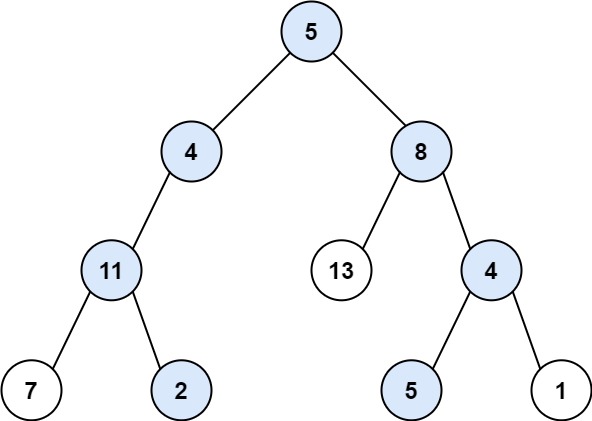
Input: root = [5,4,8,11,null,13,4,7,2,null,null,5,1], targetSum = 22
Output: [[5,4,11,2],[5,8,4,5]]
Explanation: There are two paths whose sum equals targetSum:
5 + 4 + 11 + 2 = 22
5 + 8 + 4 + 5 = 22

Example 2:
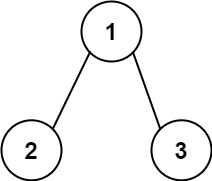
Input: root = [1,2,3], targetSum = 5
Output: []

Example 3:

Input: root = [1,2], targetSum = 0
Output: []


Constraints:

  • The number of nodes in the tree is in the range [0, 5000].
  • -1000 <= Node.val <= 1000
  • -1000 <= targetSum <= 1000

solution:

/**
 * Definition for a binary tree node.
 * struct TreeNode {
 *     int val;
 *     TreeNode *left;
 *     TreeNode *right;
 *     TreeNode() : val(0), left(nullptr), right(nullptr) {}
 *     TreeNode(int x) : val(x), left(nullptr), right(nullptr) {}
 *     TreeNode(int x, TreeNode *left, TreeNode *right) : val(x), left(left), right(right) {}
 * };
 */
class Solution {
public:
    void find_path(TreeNode* root , int ts , vector<vector<int>>&result , vector<int> insert , int sum)
    {   
        insert.push_back(root->val);
         sum = sum + root->val;
        if(sum == ts && root->left == NULL && root->right == NULL)
        {
             result.push_back(insert);
             return;
        }


        if(root->left != NULL)
        {
           find_path(root->left , ts , result , insert, sum);
        
        }
        if(root->right != NULL)
        { 
            find_path(root->right , ts , result , insert, sum);

        }
        

    }
    vector<vector<int>> pathSum(TreeNode* root, int targetSum) {
         
        vector<vector<int>>result;
        vector<int>insert;
        int sum = 0;
        if(root == NULL)
            return result;

        find_path( root , targetSum , result , insert , sum);
        return result;
    }
};


Comments

Popular posts from this blog

[PDF DOWNLOAD] AKTU Quantum series data structure b.tech 2nd year download

  All AKTU Quantums are available here. Get your hands on AKTU Quantums and boost your grades in AKTU semester exams. You can either search them category wise or can use the search bar or can manually search on this page. Download aktu second year quantum pdf data structures  download  data structures quantum aktu download aktu data structures quantum click here to download  write in comment section if you want quantum of any other subject.

Root to Leaf Paths | binary tree | geeksforgeeks solution

  Root to Leaf Paths Given a Binary Tree of size N, you need to find all the possible paths from root node to all the leaf node's of the binary tree. Example 1: Input: 1 / \ 2 3 Output: 1 2 #1 3 # Explanation: All possible paths: 1->2 1->3 Example 2: Input:   10   / \   20 30   / \   40 60 Output: 10 20 40 #10 20 60 #10 30 # Your Task: Your task is to complete the function  Paths()  that takes the root node as an argument and return all the possible path. (All the path are printed '#' separated by the driver's code.) Note:  The return type cpp:  vector java:  ArrayList> python:  list of list Expected Time Complexity:  O(N). Expected Auxiliary Space:  O(H). Note:  H is the height of the tree. Constraints: 1<=N<=10 3 Note:  The  Input/Ouput  format and  Example  given, are used for the system'...

2485. Find the Pivot Integer | Binary search

  Given a positive integer   n , find the   pivot integer   x   such that: The sum of all elements between  1  and  x  inclusively equals the sum of all elements between  x  and  n  inclusively. Return  the pivot integer  x . If no such integer exists, return  -1 . It is guaranteed that there will be at most one pivot index for the given input.   Example 1: Input: n = 8 Output: 6 Explanation: 6 is the pivot integer since: 1 + 2 + 3 + 4 + 5 + 6 = 6 + 7 + 8 = 21. Example 2: Input: n = 1 Output: 1 Explanation: 1 is the pivot integer since: 1 = 1. Example 3: Input: n = 4 Output: -1 Explanation: It can be proved that no such integer exist.   Constraints: 1 <= n <= 1000 Solution : class Solution { publ ic:     int pivotInteger( int n ) {         int sum = (( n )*( n + 1 ))/ 2 ;         int i = 1 ;         int j =...